Minimum-Zone Straightness Evaluation of Guideways: How Much Do the End-Point and Minimum-Zone Methods Differ
On the same broken line, end-point and minimum-zone straightness can differ by 20-40 %; the evaluation method must be agreed upon acceptance.
Two evaluation methods
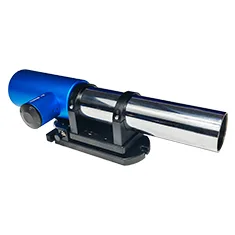
Bridge-method autocollimator measurement yields a broken line of relative heights. The end-point method draws a reference line through the first and last points and takes the sum of the largest positive and negative deviations as straightness. The minimum-zone method, per the minimum condition of GB/T 11336, encloses the whole line between two parallel straight lines of minimum separation, and that minimum width is the defined straightness error. The geometric criterion for the minimum condition is alternating contact in a high-low-high or low-high-low pattern of three points.
How large is the difference
Example: six stations with heights 0, +2.1, +1.2, +2.8, +1.0, 0 μm. The end-point line is the x-axis, the maximum deviation is +2.8, so straightness reads 2.8 μm. The minimum-zone solution puts the lower line through the two zeros and the upper line through +2.8, an alternating low-high-low pattern, giving a zone width of about 2.1 μm, roughly 25 percent smaller. As a rule, the more the profile bends in one direction, the larger the gap between the methods, commonly 20 to 40 percent; random waviness shows smaller differences.
Selection and agreement
GB/T 11336 and ISO 12780 both take the minimum-zone method as the arbitration reference; end-point and least-squares methods are approximations that err on the conservative side. A manufacturer releasing parts that pass an approximate method is safe, but any acceptance dispute must be recomputed under the minimum condition. Contracts should state the evaluation method, bridge span and station layout to avoid two different results from one data set.
Software notes
Mainstream autocollimator software reports end-point, least-squares and minimum-zone results together. When using minimum zone, verify that the software performs an exact alternating-point search rather than a simple rotation approximation, and validate it with a standard example such as the six-point data above. For repeatability, reposition the bridge for each run; three repeated evaluations should agree within 10 percent of the value, otherwise check floor vibration and thermal drift before trusting the number.