Phòng cháy bề mặt khi cắt mẫu kim tương: tiến dao, làm nguội và chọn đá
Cháy khi cắt làm biến đổi tổ chức bề mặt; ba tuyến phòng thủ: tiến dao thấp, làm nguội lớn, đá đúng loại.
How burn happens
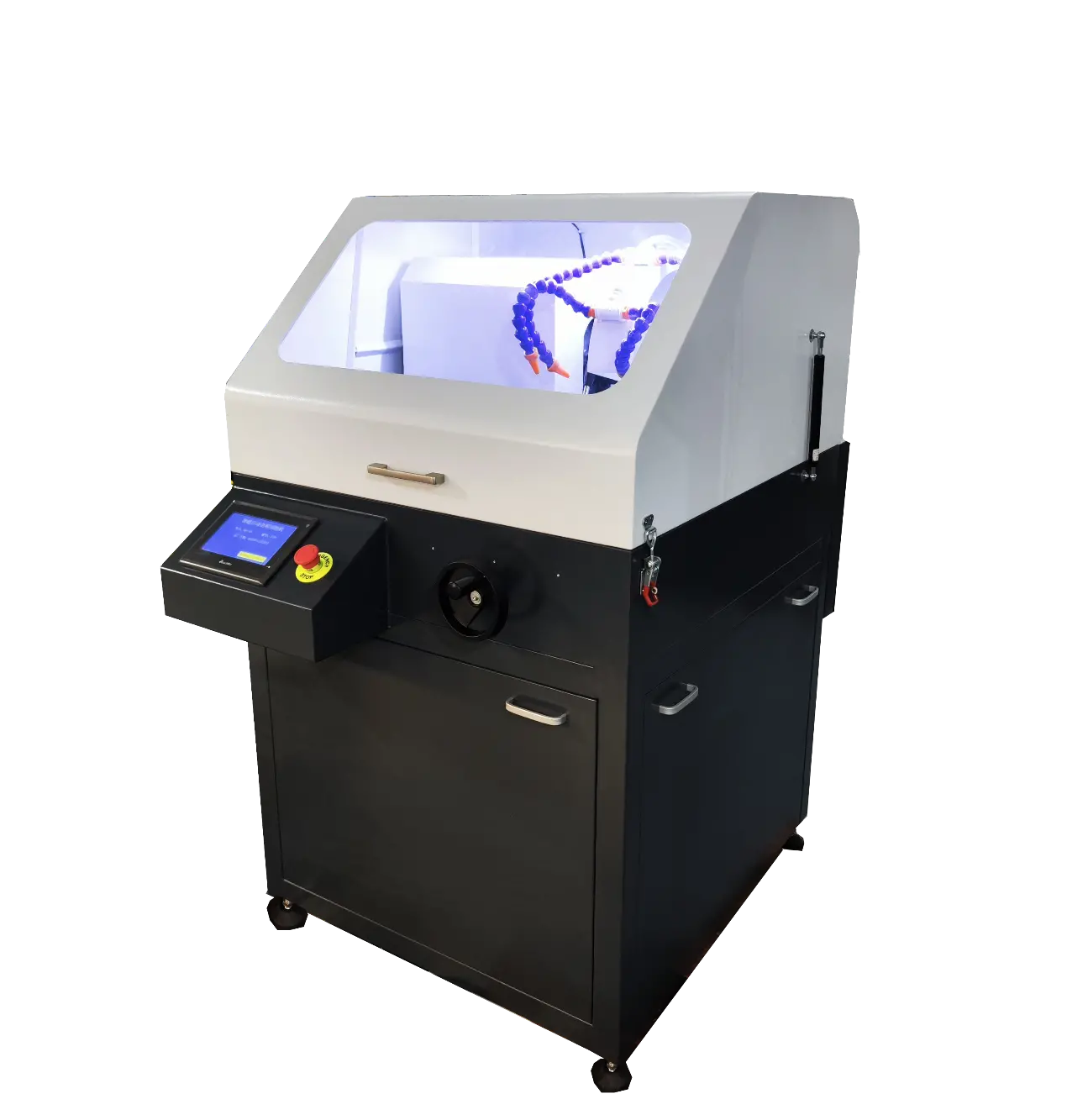
Local temperatures at the cutting zone can flash past 600 °C: with dulled abrasive grains, excessive feed or weak cooling, frictional heat pours into the outer 10-100 μm of the specimen. Quenched steels get tempered and softened, losing 100-300 HV; annealed steels austenitize and re-quench into a white martensitic skin. Either way, if grinding and polishing do not remove the affected layer, microstructure and hardness readings are all corrupted — and the layer is often mere tens of microns, easy to under-grind and miss.
Three lines of defense
- Feed control: automatic cutters at 0.01-0.05 mm/s class feeds; in manual cutting aim for even sparks without squeal, and go slower on hard stock;
- Cooling: flood the contact arc directly, at least 20 L/min of 3-5 percent emulsion, replaced regularly before it degrades;
- Wheel match: soft bonds for hard materials so grains shed and renew, hard bonds for soft metals; alumina wheels for quenched steels, diamond wheels for carbides and ceramics, silicon carbide for gummy aluminium and copper.
Detecting burn
Verify suspected burn by etching: after 4 percent nital, tempered burn darkens while rehardened white layer stays bright. Hardness is more sensitive: run an HV0.1 gradient from 0.1 mm off the cut face and compare with an uncut reference; deviations beyond 5 percent confirm an affected layer. For routine control, cut a standard coupon each shift for quick etch inspection and log affected-layer depth in the cutter checklist.
Affected layer and grinding allowance
Grinding allowance from cut face to observation plane must exceed the affected depth: allow 0.5-1 mm after conventional cutting; precision saws (low-speed diamond, 80-150 rpm) leave under 10 μm, needing only 0.1 mm. Recording cutting parameters — wheel type, speed, feed, coolant — is a baseline requirement for preparation records under ISO/IEC 17025 systems.