Длина выборки и отсечка волны: правила ISO 4288 и исключения
Ошибка на одну ступень отсечки меняет Ra на 30 %: отсечка делит шероховатость и волнистость.
Why filtering matters
A measured profile superimposes form error, waviness and roughness. The cutoff wavelength λc is the watershed: components shorter than λc enter roughness evaluation, longer ones go to waviness or form. ISO 4288, mirrored by GB/T 6062, separates them with a Gaussian filter attenuating 50 percent at λc. A larger cutoff lets more long waves inflate Ra; a smaller one filters roughness information away and deflates it — one step apart, say 0.8 versus 2.5 mm, shifts Ra by 20 to 30 percent on the same surface.
Default selection table
ISO 4288 maps expected Ra to the default λc: up to 0.1 μm use 0.25 mm; 0.1-2 μm use 0.8 mm; 2-10 μm use 2.5 mm; above 10 μm use 8 mm. The evaluation length defaults to five sampling lengths, so an Ra 0.4 μm surface means a 4 mm traverse. Rz-based tables are analogous. Instruments auto-select λc from a first reading; on inhomogeneous surfaces different spots may trigger different steps and lose comparability — lock one λc instead.
Exceptions
- Poor uniformity and large scatter: the number of sampling lengths may drop from five to three, stated in the report;
- Small flats and narrow edges: evaluate over the available length and note it;
- Periodic textures such as turning spirals: λc must exceed the feed-period wavelength, or the tool-mark wavelength is half-filtered and Ra badly distorted;
- Superfinished surfaces below Ra 0.02 μm: need the 0.08 mm cutoff plus a 2 μm stylus tip; a standard 5 μm tip can no longer resolve them.
Pre-measurement checklist
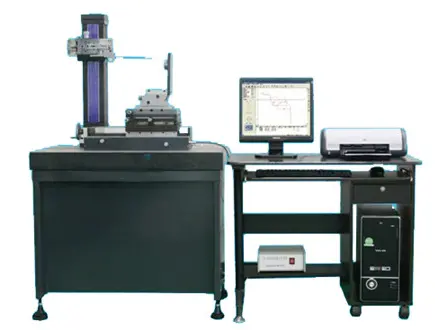
Confirm four settings before measuring: cutoff step, evaluation length, stylus radius (2 or 5 μm standard) and filter type (Gaussian; old instruments may run 2RC). When comparing two data sets, any one of these differing makes the numbers incomparable. Stating λc and evaluation length in the report is mandatory under ISO 4288.