Границы применимости динамической твёрдости Либа: масса, толщина, направление
Метод Либа динамический: масса ≥2 кг, толщина ≥5 мм; пересчёт в HRC/HB даёт ±1-2 единицы.
Principle recap
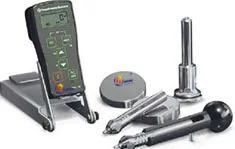
Leeb hardness (GB/T 17394, corresponding to ASTM A956) is dynamic: an impact body with a tungsten-carbide ball tip strikes the surface at a defined energy, and the ratio of rebound to impact velocity gives HL=1000×v_r/v_i. Rebound depends on elastic and plastic energy absorption, a different mechanism from static indentation hardness, so conversion to HRC, HB or HV relies on empirical curves per material family.
Three hard boundaries
- Mass: at least 2 kg for direct measurement with the D device; 0.5-2 kg requires coupling to a rigid base with grease; below 0.5 kg is basically untestable, because whole-body vibration absorbs energy and depresses readings;
- Thickness: at least 5 mm with solid backing beneath the test point; thin walls need solid support;
- Surface: Ra of 2 μm or finer for the D device, indent spacing at least 3 mm, distance from edges at least 5 mm; below 30 mm curvature radius apply correction or use the G device.
Direction correction and devices
When impact deviates from vertically downward, gravity adds or subtracts energy, so apply the instrument's direction correction. Device selection: D is general purpose; G delivers about nine times the impact energy for rough cast and forged surfaces; C is low-energy for small thin parts and hardened cases; DL has a slim front end reaching into narrow grooves.
Managing conversion uncertainty
Leeb-to-HRC conversion: with lot-specific calibration, ±1 HRC is achievable; with the generic built-in curves, ±1.5-2 HRC is normal. Recommended practice: for fixed materials in volume testing, measure three to five reference blocks on a bench Rockwell tester and then in Leeb, build a plant-specific conversion table and review it periodically — far more reliable than any generic curve. In disputes, treat Leeb as screening only; bench static testing arbitrates.